Windle, Connop, Thirlwall, Holdsworth

In the previous post I wrote about Thomas Windle, a gentleman and magistrate who lived in Mile End Old Town at the turn of the 18th and 19th centuries, and who was one of the executors of the will of Sarah Gibson in 1789. Sarah was the younger sister of my 5 x great grandmother, Elizabeth Holdsworth. When Elizabeth made her own will in 1809, one of the executors was Richard Eykin Windle, a surgeon and apothecary who (I am fairly certain) was a member of the same family as Thomas, though I’ve yet to discover their exact relationship to each other.

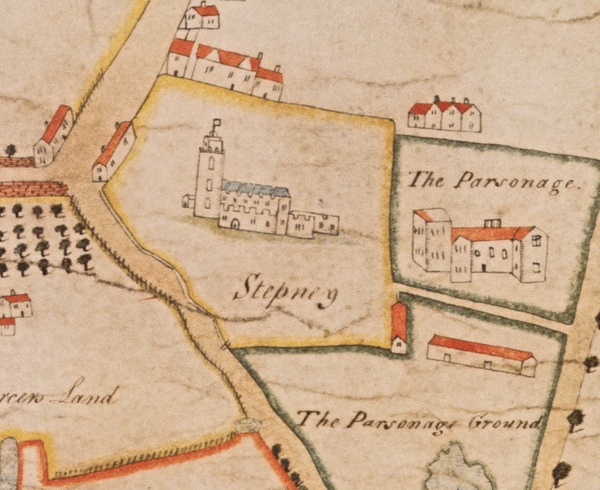
Mile End Old Town in the 18th century

Mile End Old Town in the 18th century

As I noted yesterday, Thomas Windle was the son of another gentleman of the same name, who died in Bethnal Green in 1793. Thomas Windle made his son Thomas junior the sole executor of his own will, composed in 1784. There were three witnesses to that will: Ellen Flowen (or possibly Plowen), Susanna Connop and William Connop Junior.

William Connop Junior was, as his name implies, the son of another William Connop. William Connop Senior was born in about 1717 and at the time of his marriage was said to be living in the parish of St John, Wapping. On 3rd February 1741 he declared his intention to marry Susannah Walter of the parish of St George (in the East?), Middlesex who was, like him, twenty-four years old. After their marriage the Connops lived in Mile End Old Town, where their daughter Susanna was born in 1746: she was baptised at the parish church of St Dunstan and All Saints on 9th May that year. The Connops had a son named William christened on 22nd October 1750, but he must have died in infancy, as another child of the same name was baptised at St Dunstan’s on 2nd June 1752. On 15th January 1753 a son named John was christened. All of these records describe William Connop senior as a surgeon.

18th century surgery demonstration

18th century surgery demonstration

William Connop junior was married at St Dunstan’s church on 8th October 1776. If the parish register is to be believed, his wife was another Susannah Connop – possibly a cousin. The witnesses included William Connop, presumably the groom’s father, two more Susanna Connops, perhaps his mother and sister, and a Richard Connop.  I haven’t found evidence of any children born to this second William and Susannah Connop. I’m assuming they are the people who witnessed Thomas Windle Senior’s will in 1784, but it’s possible that the Susanna named there was William Connop’s sister.

We know from his will that William Connop junior was a surgeon like his father, and from other sources that he (like Richard Eykin Windle) was also an apothecary. William made his will in June 1790 and it was proved in October of the same year: he would have been about 33 when he died. William left money to his ‘good friend’ Thomas Windle Junior of Mile End and also appointed him as one of the executors of his will.

Rev Thomas Thirlwall

Rev Thomas Thirlwall (via bbc.co.uk/arts/yourpaintings)

William Connop Junior’s widow Susannah married again on 19th June 1792. Her second husband was the curate of St Dunstan’s, Stepney, Reverend Thomas Thirlwall. The son of another vicar, Thirlwall studied at Brasenose College, Oxford and was curate at Holy Trinity in the Minories before taking up his appointment in Stepney. A prolific author, he was later appointed as Rector of Bower’s Gifford in Essex, where he died in 1827.

There’s a tenuous connection between my ancestors and Rev. Thirlwall. In 1804, my 4 x great grandfather William Holdsworth occupied property in Mile End Old Town owned by Thirlwall, who seems to have been a significant landowner in his own parish. We know that the Holdsworths had moved from Marmaduke Street, in the parish of St George in the East, sometime between 1798 and 1801, when my great-great-great-grandmother Eliza was born, in Mile End Road.

Connop Thirlwall

Connop Thirlwall

Thomas and Susannah Thirlwall had a son, born in 1797, to whom they gave the name Connop Thirlwall. He followed his father into the Church, and eventually became Bishop of St David’s in Wales. A precocious scholar and debater (John Stuart Mill once described him as the best public speaker he had ever heard), he was elected a fellow of Trinity College, Cambridge, and tried his hand at the law, before becoming a clergyman, a role he combined with that of noted historian and author. Connop Thirlwall died in 1875.

Posted in Gibson, Holdsworth, Windle | Leave a comment

Thomas Windle Esquire of Mile End Old Town

In the last post I wrote about the family of Richard Eykin Windle, a London surgeon and apothecary at the turn of the eighteenth and nineteenth centuries, who acted as executor of the will of my 5 x great grandmother Elizabeth Holdsworth née Gibson in 1809. I reported my discovery that his brother, oil and colour merchant John Hattam Windle, might have been a business partner of William Parker, who married Elizabeth’s daughter Sarah six years earlier.

One of the reasons for my interest in the Windles is that the reference to Richard in Elizabeth Holdsworth’s will is not the first record of that family’s connection with my ancestors. Twenty years earlier, in 1789, Elizabeth’s unmarried sister Sarah Gibson nominated ‘Thomas Windle Junior Esquire of Mile End in the parish of Stepney’ as co-executor of her own will, together with her brother Bowes John Gibson.

Stmatthewsbethnalgreen

Who was Thomas Windle, and what was his relationship, if any, to Richard Eykin Windle? I’m fairly sure that Thomas Windle senior, the father of the man named in Sarah Gibson’s will, was the person of that name who was buried at St Matthew’s church, Bethnal Green on 23rd April 1793. He would still have been alive when Sarah Gibson made her will four years earlier, thus making it important to describe his son as Thomas Windle Junior. Thomas Windle Senior had actually made his own will some years earlier, in 1784. From that document we learn that by then he was a widower: he asks to be buried ‘in a strong oak coffin filled up with sawdust as my wife was that my corpse may be directly laid over hers’. Rather confusingly, and perhaps as the result of an error, Thomas leaves property to ‘my son William Windle’ and in the same sentence appoints ‘my said son Thomas Windle’ as his sole executor. He signs his will ‘Thomas Windle Sen.’ and it was proved by ‘Thomas Windle Esquire the son of the deceased’.

Section of Horwood's 1792 map, showing Mile End Old Town

Section of Horwood’s 1792 map, showing Mile End Old Town

There are various land tax records from the 1780s for properties in Bethnal Green belonging to Thomas Windle – presumably ‘Senior’, since all of the records for his son Thomas Windle Junior place him in Mile End Old Town. For example, in 1793, Thomas Windle Esquire of Mile End can be found in a list of subscribing members of the Society for the Promotion of Christian Knowledge. In 1797, his name was proposed, for the King’s approval, as one of the deputy lieutenants of the Tower Hamlets militia, and by 1818 he had been appointed to that position, as well as being a magistrate. There are countless land tax records for Thomas Windle Esquire of Mile End or Stepney, from the 1790s through to about 1825. He also seems to have owned property elsewhere in London, including two houses in Rosemary Lane, Whitechapel. In 1807, Thomas Windle both occupied and owned properties on Mile End Road South. This means he was a near neighbour of the Gibson family, including Bowes John Gibson, brother to Elizabeth and Sarah, and the other executor of the latter’s will.

Thomas Windle Esquire of Mile End seems to have been married twice and to have had three children, two of whom survived. On 3rd January 1791, Thomas Hattam Windle was christened at the church of St Dunstan and All Saints, Stepney. He was the son of Thomas Windle Esq of Mile End Old Town and his wife Elizabeth. The name ‘Hattam’ provides an immediate connection with the family of Richard Windle, three of whose siblings had the same middle name, and at least two of whom passed it on to their own children.

Sadly, this particular Thomas Hattam Windle died when he was only three months old. His mother Elizabeth must have died soon afterwards, perhaps in childbirth, since in 1794, Thomas Windle, a gentleman of Mile End Old Town, and his wife Frances, had a daughter named Mary baptised at St Dunstan’s. The same couple’s daughter Sarah was christened there two years later, in 1796.

I can’t find records of any other children born to Thomas Windle after this date, nor have I found either marriage or death records for Thomas, Elizabeth or Frances. The absence of a will for Thomas seems very odd, too, particularly since Thomas Windle Junior seems to have left his two surviving children well provided for.

Neither Mary nor Sarah Windle married, and in fact the two sisters seem to have lived together on their inherited income for the remainder of their lives. They appear to have moved around the south of England, using their shared inheritance to endow and support various High Anglican churches. At the time of the 1841 census they were both in their forties, living on independent means, and sharing a house in Oxford with Stephen Reay, his wife Eleanora, and a young female servant.  The census record describes Stephen as a ‘clerk’, but that hardly does him justice: he was a clergyman, professor of Arabic at Oxford, and sub-Librarian at the Bodleian.

In 1851 the Windle sisters were living in High Road, Leyton, Essex, with two female servants: Mary and Sarah described themselves to the census clerk as a ‘gentleman’s daughters’. The sisters were said to be ‘fundholders’ ten years later, when the 1861 census found them living with a cook and housemaid in Brighton, where they appear to have funded the building of a new Anglo-Catholic church.

Church of St Michael and All Angels, Brighton, built with financial support from the Windle sisters

Church of St Michael and All Angels, Brighton, built with financial support from the Windle sisters

By 1871 Mary and Sarah had moved back to Oxford, to Stanley Villa at 2 St Giles Road, Headington. When the census was taken in that year they had a visitor: John William Burgon, the vicar of the university church of St Mary the Virgin, later the Dean of Chichester.

It was at Stanley Villa that Mary Windle died on 11th July 1880, at the age of 86, leaving a personal estate valued at ‘under £9,000’. I haven’t found a record for her sister Sarah’s death, but I assume it must also have been in 1880, since before the year was out, Rev Burgon would erect a stained glass window in the parish church of Houghton Conquest, Bedfordshire, as a memorial to three benefactors, Eliza Hargrave and Mary and Sarah Windle.

Rev. John William Burgon

Rev. John William Burgon

What do we know about the origins of Thomas Windle Esquire and his connection with the Windles of Shropshire? If he was, as seems likely, the son of Thomas Windle (Senior) of Bethnal Green, then perhaps he was the son of Thomas and Sarah Windle of Bethnal Green who was christened at St Mary, Whitechapel, in 30th October 1748. On the other hand, that would mean he was already 43 when his first son Thomas Hattam Windle was born in 1791, which seems unlikely: so perhaps this was his father and there was a third Thomas Windle in the generation before? At any rate, the Thomas and Sarah Windle whose child were christened in 1748 were almost certainly the couple who declared their intention to marry in an allegation of 29th October 1747. Thomas Windle was said to be a 30-year-old ‘chymist and widower’ of St Mary Magdalen, Old Fish Street in the City of London, while his bride to be was Sarah Sculthorpe, a 26-year-old widow of the parish of St Mary, Whitechapel (though interestingly the Sculthorpes seem to have been associated with the parish of St Sepulchre, Holborn, the favoured London church of the Windle family). According to a record found at origins.net, in 1762 Thomas son of Thomas Windle of Old Fish Street, London, chemist was apprenticed to to Rees Williams, 17 Dec 1762, of the Fishmongers’ Company.

The fact that Thomas Windle Esquire Junior of Mile End Old Town gave his short-lived son the middle name ‘Hattam’ identifies him as a member of the same family as Richard Eykin Windle. However, the precise nature of his connection to that family remains to be determined.

Posted in Gibson, Holdsworth, Parker, Uncategorized, Windle | Leave a comment

Who were the Windles?

My 5 x great grandmother Elizabeth Holdsworth née Gibson died on 1st March 1809 at the age of 76 and was buried a week later in the churchyard of St Dunstan and All Saints, Stepney. In her last will and testament, signed and sealed on 11th February, Elizabeth appointed Sarah Parker as her executrix and Richard E. Windle as executor.

Sarah Parker was Elizabeth’s daughter from her second marriage, to Joseph Holdsworth, who had died fourteen years before in 1795. Born in South Weald, Essex, Sarah had first married plumber Edward Porter at St Botolph’s church, Bishopsgate, in 1786, when she was nineteen. Edward died in Mile End Old Town in 1799 at the age of 33, leaving Sarah with a five-year-old child, also named Edward, who died three years later in 1802. In the following year, Sarah married William Parker of Whitechapel at the church of St Matthew, Bethnal Green.

William Parker was one of the witnesses to his mother-in-law Elizabeth Holdsworth’s will, as was Sarah herself, together with her younger brother, my 4 x great grandfather William Holdsworth. The fourth witness was Richard Windle, the same person that Elizabeth had appointed to act as executor of the will.

Who was Richard Windle? The question is made more interesting by the fact that another person with the same surname, Thomas Windle, had been appointed as co-executor of her will by Elizabeth’s unmarried sister, Sarah Gibson, some twenty years earlier, in 1789. So who were the Windles, and what was their relationship to the Holdsworths?

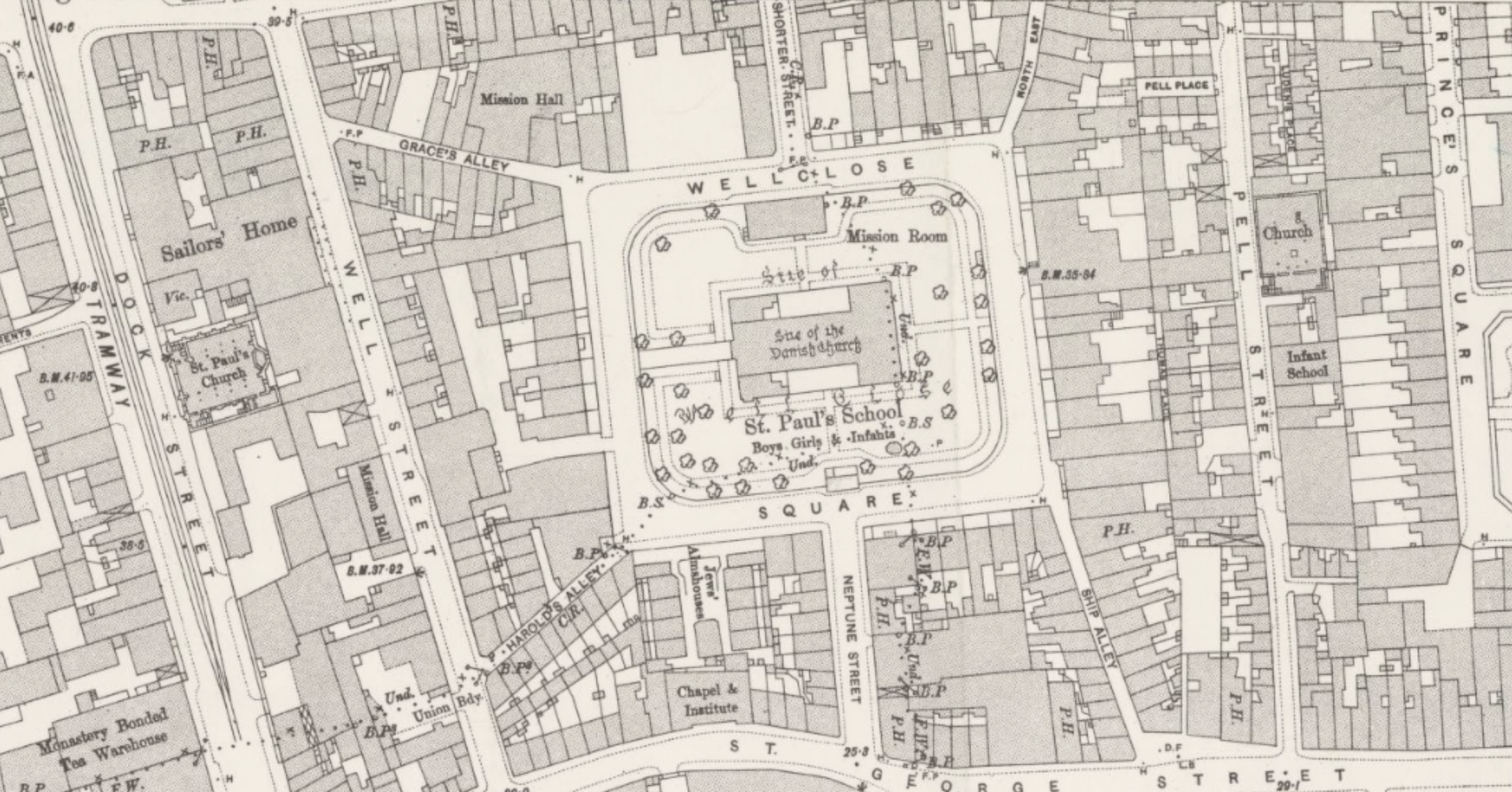
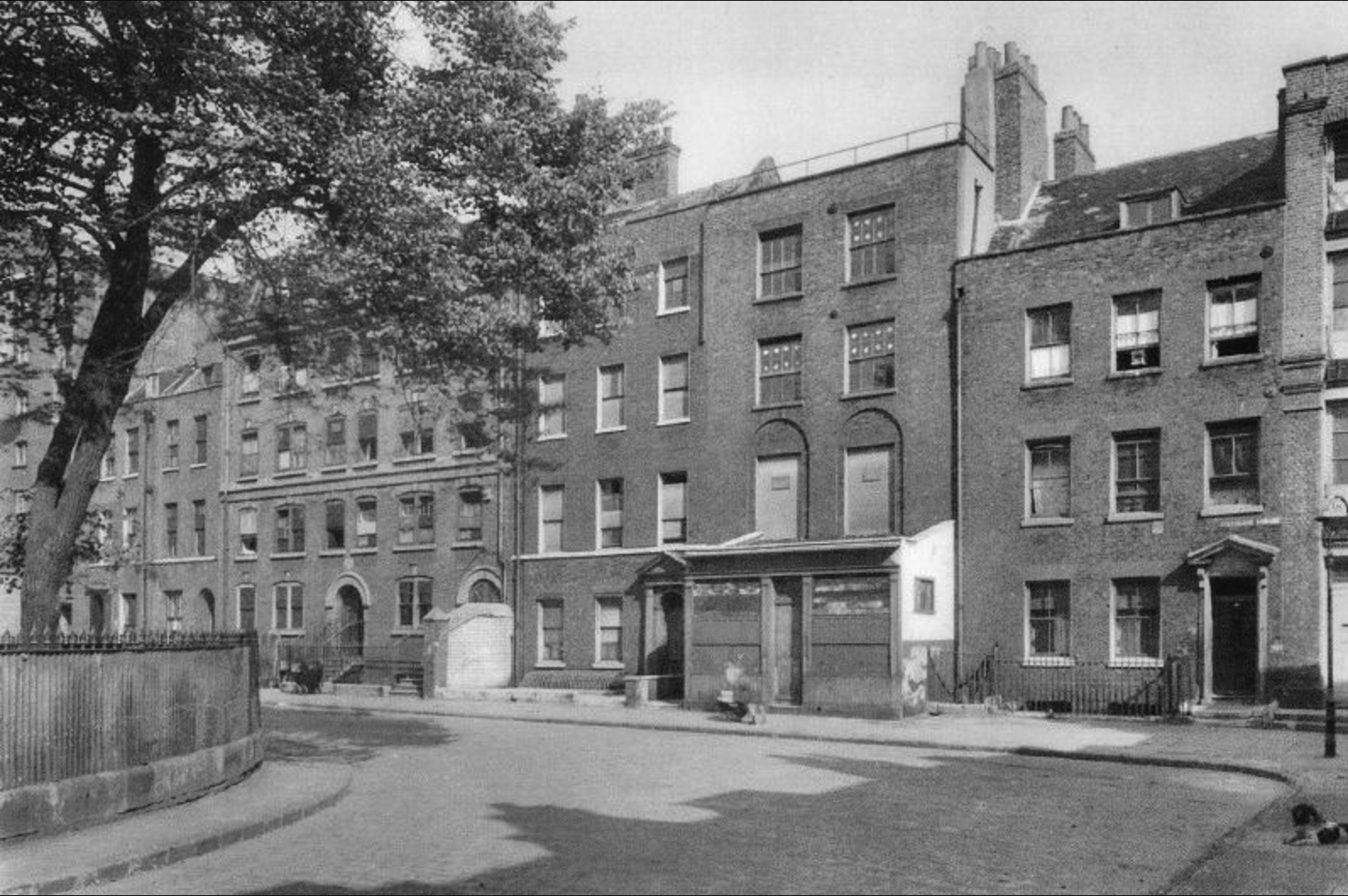
Early photograph of Wellclose Square

Early photograph of Wellclose Square

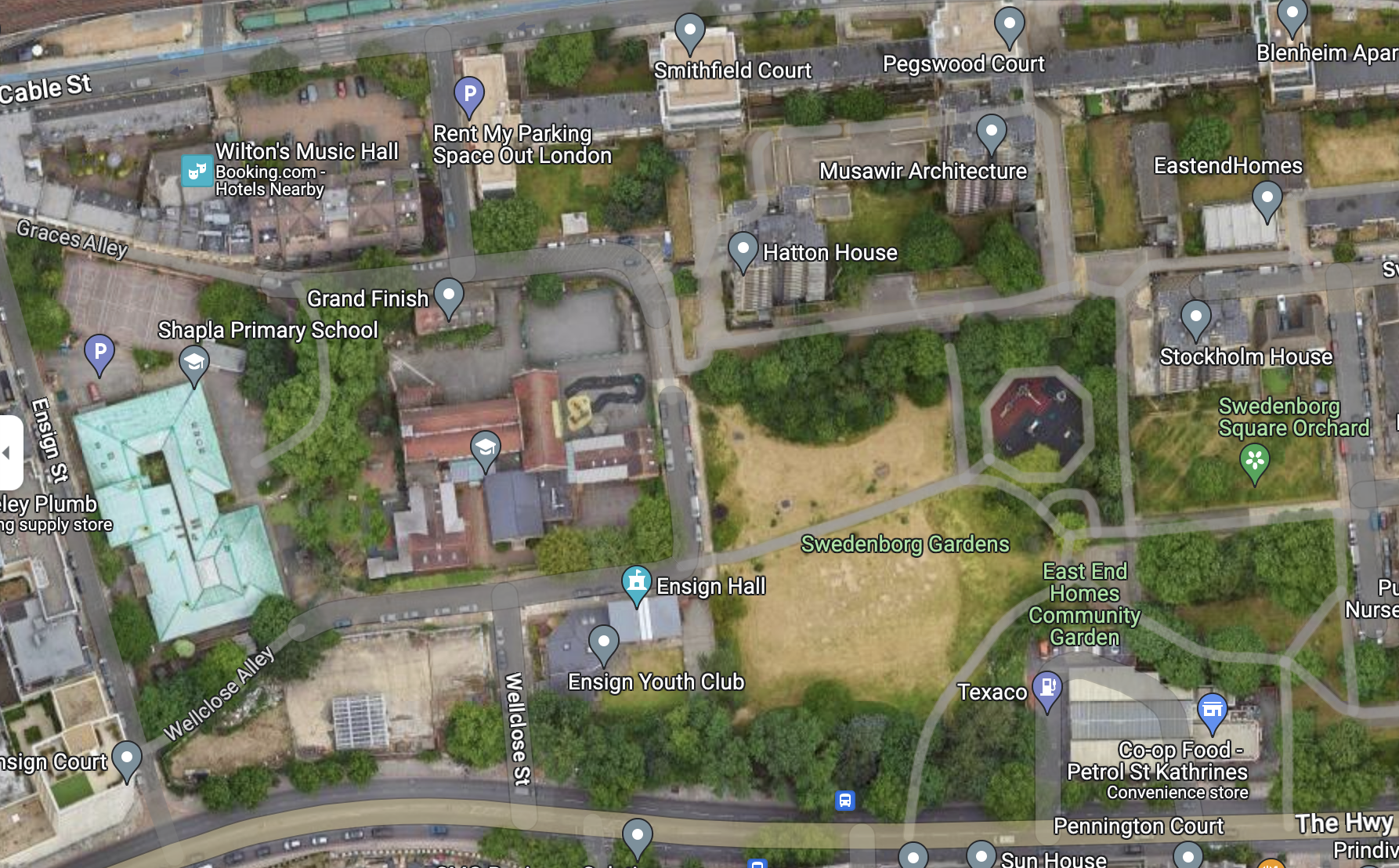
I’m reasonably certain that the Richard E. Windle named in Elizabeth Holdsworth’s will was Richard Eykyn Windle, a surgeon and apothecary who lived in Wellclose Square, Whitechapel. He was born in 1782 in Claverley, Shropshire, the son of another Richard Windle (1721 – 1786) and his wife Anne Eykin (1746 – 1786). The Windles and the Eykins, rather like my Byne and Manser ancestors, seem to have combined rural, landowning roots with a foothold in London and in ‘trade’. Richard Windle senior and Anne Eykin had married at the church of St Sepulchre, Holborn, in 1779: at the time, he was a widower of 57 while she was a spinster of 33.

Like the Windles, the Eykin family had their origins in Shropshire. Ann was the daughter of John Eykin of Ackleton and Martha Pitt of Astley Abbotts. However, at least one of her siblings had also been married at St Sepulchre’s, Holborn: four years earlier her younger brother John had married Elizabeth Browning there. John Eykin junior remained in London, living at Smithfield Bars and working as an oil merchant.

Church of St Sepulchre, Holborn

Church of St Sepulchre, Holborn

Richard Eykyn Windle was the fourth of five children, his siblings being Thomas Hattam Windle (born 1779), John Hattam Windle (1780), Ann Hattam Windle (1782) and Edward Whitmore Windle (1784). Thomas, the eldest son, appears to have remained in Shropshire and inherited the family farm at Claverley. The 1851 census describes him as a farmer of 126 acres employing 11 labourers. His younger siblings all seem to have moved to London. Ann Hattam Windle married James West, a widower from the parish of St Mary, Rotherhithe, in 1801. Edward Whitmore Windle married Anne Jones at St Leonard’s, Shoreditch, in 1804, and then followed his sister to Rotherhithe, before settling in Stepney.

Parish church, Claverley, Shropshire

Parish church, Claverley, Shropshire

As for John Hattam Windle, he followed a similar profession to his cousin John Eykin, working as an oil and colour merchant. In 1811 John married Jane Byron at St Mary’s church, Whitechapel. She was the daughter of John Byron of 50 Whitechapel (High Street), who may also have been an oil and colourman. Certainly his son George was, and he and John Windle went into business together at the same address: they insured their premises together in 1826.

However, before setting up shop with his brother-in-law, John Windle had been be involved in another partnership, a few doors away in the same street. On 1st July 1812, this notice appeared in the London Gazette:

The Copartnership existing between us, and carried on under the firm of Parker and Windle, Oil and Colourmen, at No. 47, Whitechapel, in the County of Middlesex, was this day dissolved by mutual consent.—Witness our Hands,

William Parker. John Hattam Windle

Could this be the William Parker who married Sarah Porter née Holdsworth in 1803? After all, we know from the marriage record that he was from Whitechapel. And if so, does this help to explain the connection between the Windles and the Holdsworths?

It may not be a coincidence that a month after he dissolved his partnership with John Hattam Windle, William Parker took out a patent for an improvement in the manufacture of green paint. His fortunes were shortlived, however: six years later, in June 1818, William Parker of High Street, Whitechapel, Middlesex, oilman and colour manufacturer, was declared bankrupt.

Colourman's shop

Colourman’s shop

I’ve found the will of a Whitechapel oil and colourman named William Parker, but he died in 1799. At first, I thought that the William who was in partnership with John Windle might be his son. However, the will fails to mention any children. On the other hand, there is a reference to a nephew named William, as well as a niece named Sarah. William’s mother Mary is also mentioned, which should help in tracing the family.

According to the Whitechapel parish register, William Parker of High Street was buried on 11th August 1799. This fits with the dates on the will: it was signed on 26th June and proved on 13th August. Helpfully, the register tells us that William was 50 years old when he died, so he was born in about 1749. The cause of death seems to have been dropsy. Interestingly, on the very same day, Mary Parker, aged 82, from the same address, was buried; she died of old age. I assume this was William’s mother.

Church of St Mary, Whitechapel

Church of St Mary, Whitechapel

We now need to find a William Parker born in about 1749 to a mother named Mary, who was herself born in about 1717. We then need to discover another son born to the same parents, who had children named William and Sarah. Perhaps doing so will help to solve some of the mysteries surrounding the connections between the Parkers and the Holdsworths. For the link did not begin with the younger William Parker marriage to Sarah Porter in 1803. Nine years earlier, when married to Edward Porter, Sarah had given her son the name Edward Parker Porter, suggesting an already-existing association with the family, perhaps through Edward senior. Then there is the question of whether the Thomas Parker who married another Sarah Holdsworth, daughter of my 4 x great grandfather William, in 1821, was a member of the same family.

I’ll be following the trail of the Parkers and the Windles in future posts. I’m still not sure how, if at all, the Thomas Windle who witnesses the will of Sarah Gibson in 1789 was connected to Richard Windle and his family.

To return finally to Richard Eykin Windle. He died less than two years after witnessing the will of Elizabeth Holdsworth, at the age of 28, and was buried on 5th January 1811 in a vault, presumably one belonging to his family, at the church of St Sepulchre, Holborn. According to the parish register, his address was Smithfield Bars, though in his will, he states that he lives at Wellclose Square. Perhaps he spent his final days being cared for by his uncle and aunt, John and Elizabeth Eykin, who lived at the former address? Certainly his will was signed and sealed there, and makes prominent mention of his uncle and aunt, as well as his now-widowed sister Anne West and his brother John.

Richard’s younger brother Edward Whitmore Windle died seven months after him, at the age of 27, and was buried in the same vault at St Sepulchre’s. John Hattam Windle died at Montague Street, Whitechapel, in 1833 at the age of 52 and was buried at St Mary’s church, Whitechapel. At the time of the 1861 census, his widow Jane, now 75, could be found living in Osborne Street, Whitechapel, with her two unmarried daughters Jane and Elizabeth, her son Hattam, a clerk in a London bank, her 80-year-old brother (and her late husband’s erstwhile business partner) George, and three servants.

Posted in Gibson, Holdsworth, Parker, Windle | Leave a comment

Written before the mast: the last will and testament of Alexander Curtis

Earlier this week I wrote about the daughters of William Greene, the 17th century Stepney chirurgeon who may turn out to be one of my ancestors. By researching his family, I’m hoping to discover whether William was a relative (perhaps even the father) of my 8 x great grandfather, Captain William Greene.

17th century naval battle

17th century naval battle

I believe that at least two of William’s daughters married mariners: Elizabeth married Richard Benson in 1658, and in 1662 her sister Mary married Alexander Curtis. In my earlier post I noted that Alexander’s father was John Curtis, a mariner and gunner, while he himself worked as a purser, initially on the ‘Monck’ and then on the ‘Newcastle’. Both were ships of the English navy, firstly under Cromwell’s Commonwealth and later in the service of the King. Alexander Curtis was serving as a purser on ‘his Majestie’s ship Newcastle’ when he wrote his last will and testament in 1677, at the age of 35. In fact, we can tell from the will itself that it was actually written at sea: Alexander asks to be buried in the next ‘Christian dock or place’ that his ship comes to, and stipulates that his personal belongings should be ‘sold before the Mast’.

There is no mention in the will of Alexander’s wife Mary, so we must assume that she had died before this date. However, the names of the children mentioned align with what we know of the family of Alexander Curtis and Mary Greene. Only William, born in 1668, does not appear to have survived until 1677.  As for those who are mentioned here: John would have been fourteen, Alexander junior twelve, Thomas eight, and Mary four, when their father died. It’s interesting that Alexander names his father John as one of his executors, since the latter must have been at least seventy when this was written and (unusually for the times) would outlive his son.

Greenville Collins' mapping of the British coastline

Greenville Collins’ mapping of the British coastline

Alexander Curtis appoints two other executors of his will. One is Captain Bernard Ludman, who was commanding officer of Alexander’s previous ship, the ‘Monck’, and then the ‘Victory’, though one source claims that he had died in 1673: either this is a mistake, or Alexander was not aware of it, or he was not (as he claimed) ‘of perfect memory and remembrance’ when he wrote his will. In the early 1670s Ludman commanded the ‘Monck’ in various engagements against the Dutch navy, in which Alexander Curtis was presumably also involved. The third executor of the will was John Ansell: could he be the buccaneer of that name who sailed with the notorious Admiral Henry Morgan and died in 1689?

Alexander asks the Newcastle’s ‘master’, Greenville Collins, who also witnesses the will, to take an inventory of his effects. Collins would later become commander of the ‘Charles’ and a noted map-maker: in fact, he was appointed by Samuel Pepys to survey the coasts of the British Isles, the results of which became enormously influential, and he was later made ‘hydographer to the King’ (see image above). Benjamin Walter(s), described here as the steward of the ‘Newcastle’, would go on to become a naval captain and commanding officer, serving in a number of battles against the French in the Nine Years War.

Part of Rocque's 1746 map of London, showing Cock Hill, Ratcliff

Part of Rocque’s 1746 map of London, showing Cock Hill, Ratcliff

Alexander Curtis’ will gives us some idea of where his family lived. He mentions the house currently occupied by his father John, but owned by himself, at ‘Cockhill’ in the hamlet of Ratcliff. Cock Hill was at the western edge of Ratcliff, extending southwards from Upper Shadwell (where we know Alexander and Elizabeth Curtis lived at one point) to Lower Shadwell and the riverside.

My transcription of Alexander Curtis’ will follows: 

In the Name of God Amen: The eighth of December in the yeare One thousand six hundred seventie seven according to the Computation of the Church of England I Alexander Curtis Purser of his Majestie’s ship Newcastle being of perfect memory and remembrance, Praised be God, doe make and ordaine this my last Will and Testament in manner and forme following (viz) First I bequeath my Soul into the hands of Almightie God my Maker hoping through the meritorious Death and passion of Jesus Christ my only Saviour and Redeemer to receive free pardon and forgiveness of all my Synns, And as for my Bodie to be buried in Christian Buriall at the first Christian dock or place his Majestie’s said Shipp Newcastle shall come at: Item I give unto my Sonn John Curtis my Sonn Alexander Curtis my Sonn Thomas Curtis and my daughter Mary Curtis All those moneys Goods houses Lands and Chatells which I have owing unto mee or shall be myne at any maner of tyme or tymes whatsoever to be equally distributed betweene all my said Children before exprest, making and ordaining by this my last Will and Testament John Curtis my deare Father Captaine Bernard Ludman and John Ansell my Executors, to see all my Children have all that is myne equally distributed betweene them, and likewise that my daughter Mary may have that house which my said Father John Curtis has nowe in his possession, and which is myne for her bringing upp to maturitie, which house lyes scituate by Cockhill in Ratcliff in the Countie of Middx; And likewise all those Cloathes and Sea-necessaries which are myne I desire may be sold before the Mast, and an Inventary taken of all by Greenvill Collins master and Benjamin Walter my Steward of the Newcastle to be delivered to my Executors before exprest for the use of my Children; And in witness whereof I have hereunto set my hand and Seale the day first above written. Alex: Curtis. Signed sealed in the presence of G. Collins: Benj. Walter: John Powell; J. Hunton; Since the signing and sealing of the Will before-writt I Alexander Curtis give unto my Sonn John Curtis one watch, and a Seale Ring, And one small Ring to my Sonn Alexander Curtis, And another to my Sonn Thomas Curtis, And likewise a Gold Watch with all lynnen, which belongs to women, and which is in England I doe desire that my daughter Mary Curtis may have: Alex: Curtis:.

Posted in Curtis, Greene | Leave a comment

One surgeon and two apothecaries: three generations of John Bodingtons in Stepney

I’m grateful to Janet Payne, Archives Volunteer at the Worshipful Society of Apothecaries of London, for responding to my enquiries about John Bodington of Stepney. Her information provides valuable confirmation of connections about which I could only speculate in earlier posts.

Apothecaries Hall, London

Apothecaries Hall, London

If you’ve followed my previous posts on John Bodington, you’ll recall that my interest in him was sparked by his will of 1728, in which he not only names my 7 x great grandfather, goldsmith Joseph Greene (1677 – 1738), as an executor, but also declares a stake in the property of Joseph’s mother-in-law (and my 8 x great grandmother) Alice Byne. So far, my researches into the Bodingtons of Stepney have revealed that an earlier John Bodington, almost certainly a relative of the apothecary who wrote his will in 1728, was a barber-surgeon, apprenticed to William Greene , chirurgeon of Ratcliffe (died 1656), and married to his daughter Margaret. This is of interest to me because William is a prime candidate to be the father of my 8 x great grandfather, Captain William Greene (died 1686).

Janet’s research on my behalf seems to confirm what I already suspected: that there were actually three generations of John Bodingtons living in Stepney in the 17th and early 18th centuries, the first a barber-surgeon and the second and third both apothecaries. Starting with the third John Bodington, the man who wrote his will in 1728 and was a close friend of Joseph Greene: it seems that he was included in the Yeomanry list of the Society in 1702 and appears in the Livery List in both 1719 and 1727. I’m fairly sure he is also the person that Janet has found in a list of Apothecary Apprentices 1670-1800, which mentions the apprenticing of ‘Bodington John s[on of] John, citizen and apothecary to John Hemingway 1 Dec 1691’.

An apothecary's pestle and mortar from 1662 (via apothecaries.org)

An apothecary’s pestle and mortar from 1662 (via apothecaries.org)

In other words, this third John Bodington – let’s call him John Bodington (3) – was the son of another apothecary bearing the same name – whom we’ll call John Bodington (2). Even more interesting for our purposes is the information contained in a record of London Apprentices for the years 1617-1669, in the volume headed ‘Apothecaries’ which reads as follows:

Boddington John s[on of] John [of] London, Citizen + Barber Surgeon to Thomas Elton 3rd May 1659 

I’m fairly sure that the apprentice named here was the aforementioned John Bodington (2), and that his father, the barber-surgeon, whom we’ll call John Bodington (1), was the person who was apprenticed to William Greene and who married the latter’s daughter Margaret in 1638.

Putting everything in chronological order, let’s try to summarise what we know about each of these three men.

John Bodington(1)

He was a chirurgeon or barber-surgeon, apprenticed to William Greene of Stepney, probably born some time around 1620. He married William’s daughter Margaret, 19, at St Dunstan’s, Stepney, in 1638.

I’ve found evidence of two daughters born to John and Margaret Boddington. In 1643, John Bodington of Shadwell, chirurgeon, and his wife Margaret, had a daughter named Anne christened at St Dunstan’s. In 1662, the same couple had a daughter Elizabeth baptised; she died three years later.

If John Bodington (2) was the son of John and Margaret, and his apprenticeship records seems to suggest this was the case, then he was probably born some time around 1645, given that he was apprenticed in 1658 and I believe fourteen was the usual age for this to take place. The fact that I’ve yet to find a christening record for John need not concern us unduly, since this was at the height of the Civil War when parish registers were often interrupted.

I haven’t found a burial record for John Bodington (1) or any trace of a will, a document that would be extremely useful in confirming the links not only between the different generations of the Bodington family, but more importantly between the Bodingtons and the Greenes.

St Dunstan's, Stepney (George Shepherd, 1818)

St Dunstan’s, Stepney (George Shepherd, 1818)

John Bodington (2)

He was apprenticed to Thomas Elton, apothecary, in 1659. (In 1691, Thomas Elton, apothecary at Mile End Green, was nominated as a governor of Bridewell Royal Hospital, and a few years later someone of that name was paying tax on property in Broad Street, Ratcliffe. At one stage he was also Master of the Society of Apothecaries of London. )

I suspect that it was John Bodington (2) who was married to a woman named Joan. In November 1673, Margaret, daughter of John Bodington, an apothecary in Ratcliff, was buried at St Dunstan’s.  In 1682, John and Joan Bodington had a daughter named Elizabeth christened. In 1684, the same couple had a son Richard baptised. In 1688, John Bodington was on the Livery List of the Society of Apothecaries of London.

If John Bodington (3) was the son of this John Bodington, then he was probably born around 1677, since he was apprenticed in 1691. Incidentally, this would make him the same age as his friend, my ancestor Joseph Greene who, even if it turns out they weren’t related, would have been a neighbour in the hamlet of Ratcliffe where they both grew up. Once again, however, I’ve been unable to find any record of this John Bodington’s birth.

I’m fairly certain that the John Bodington, apothecary of Ratcliffe, who was buried at St Dunstan’s in 1698 was John Bodington (2). If my calculations are correct, he would have been about 53 years old.

John Bodington (3)

Born in about 1677, he was apprenticed to John Hemingway, apothecary, in 1691 and was a freeman by 1701. (I wonder if Hemingway was a descendant of his namesake, who was apothecary to Elizabeth I?) I’ve found no evidence of a marriage for this third John Bodington, or of any children born to him. Nor are any close relatives mentioned in his will of 1728. As I’ve noted before, the main beneficiary of Bodington’s will is his fourteen-year-old goddaughter Mary Johnson, but I’ve yet to work out her exact relationship to him.

If nothing else, this new information from the archives of the Worshipful Society of Apothecaries establishes a direct link between the John Bodington who married Margaret, daughter of William Greene, and the John Bodington who was connected with Joseph Greene and Alice Byne: they were almost certainly grandfather and grandson. Of course, John Bodington (3) and Joseph Greene could simply have been childhood friends and neighbours. But the fact that John’s grandmother was a Greene points towards a closer tie. Was Joseph Greene’s father, Captain William Greene, the brother of John Bodington’s grandmother, Margaret Greene? And was William Greene, chirurgeon, both John’s great grandfather and Joseph’s grandfather?

Posted in Bodington, Byne, Greene | Leave a comment

The children of William Greene, chirurgeon

I’m grateful to my fellow researcher and distant relative Ron Roe for his comments on my recent reflections concerning William Greene, the seventeenth-century Stepney chirurgeon who may yet turn out to be one of our ancestors. Ron tends to agree with me that the names Agnes and Anne were probably interchangeable in records at this period, which would mean that all of William Greene’s children were born to the same mother, his first wife, who died in 1643. Confusingly, William’s second wife was also called Anne: in 1645 he married Anne Roades, the widow of his fellow barber-surgeon Richard Roades, but they do not appear to have had any children together.

'Barber-Surgeon Tending a Peasant’s Foot', Isaack Kodijek, 1649-50

‘Barber-Surgeon Tending a Peasant’s Foot’, Isaack Kodijek, 1649-50

In this post, I want to set down what we know about the children of William Greene, chirurgeon. I’m still hoping to find a reference, in a will or a marriage record perhaps, to my 8 x great grandfather Captain William Greene, the Stepney mariner who might possibly be related to this other Greene family living in the same parish at about the same time.

By my reckoning, William and Agnes or Anne Greene had nine children, of whom eight seem to have survived to adulthood. Margaret Greene was born in 1619, and is almost certainly the person who married William Greene’s apprentice, John Bodington, in 1638. William Greene junior was born in 1624: we nothing more about him, though he may still turn out to be my ancestor, Captain Greene. Anne Greene was born in 1626, but I’ve found no further records for her. Emmanuel was born in 1628 but died in 1632. That leaves the four youngest daughters mentioned in William’s will of 1654: Mary, born in 1631; Elizabeth, 1633; Ellen, 1636; and Abigail, 1639.

I’ve searched for records of the marriages of these four daughters, all of whom were still unmarried at the time that their father wrote his will, and I believe I’ve found a fairly convincing match for three of them. The only daughter I’ve so far failed to find a match for is Abigail, the youngest, who would have been only seven years old when her father died in 1656.  The main difficulty in being sure about any of these records is the fact that both the surname Greene, and these women’s Christian names, were extremely common. However, once we take into account dates, ages and location, we can be reasonably certain that we’re on the right track.

I believe that the first of the three Greene sisters to marry was Ellen. She is also the daughter about whom I’ve been able to discover the least. All we know is that on 20th December 1656 Henry Newbury, 22, of Spitalfields married ‘Elen Greene of Ratcliff Mayde aged 20 yeares’ at the parish church of St Dunstan and All Saints, Stepney. Since Ellen was born in 1636 in Ratcliffe, these details are a perfect match. Despite my best efforts, I’ve failed to find any evidence of children born to this couple, or to discover anything definitive about Henry. In 1630 a Henry Newberrie or Newberry, a sailor on the Maurice, made his will: might this have been Henry’s father? If so, and if the Henry Newbury who married Ellen Greene was also a sailor, then it would mean that all three Greene daughters married mariners.

'The Wedding Party', Jan Steen, 1667

‘The Wedding Party’, Jan Steen, 1667

On 2nd May 1658, also at St Dunstan’s church, Richard Benson, a 23-year old-mariner from Ratcliffe, married Elizabeth Greene, a ‘maid’ of the same age, and from the same place. Richard was probably the son of James Benson, also a mariner from Ratcliffe, and his wife Anne, christened at St Dunstan’s on 17th July 1634.  On 8th July 1665, when he was about 31 years old, Richard Benson was awarded his Master’s certificate by Trinity House.

Richard and Elizabeth Benson appear to have had two children, a son and a daughter. Their daughter Elizabeth was baptised on 29th March 1666. Two years later, on 4th August 1668, their son Richard was christened. Both were born at White Horse Street in Ratcliffe.

I haven’t found any further records for Richard Benson senior or his wife Elizabeth. I’ve seen a copy of a will made in March 1694 by Richard Benson, mariner, ‘now belonging to His Majesty’s ship Royal William’, which names ‘my loving sister Elizabeth Benson of the parish of St Lawrence Jewry London’ as his heir and lawful attorney.’ I suspect this was written by Richard junior rather than his father. If still living, then the latter would have been sixty years old when it was written, probably too old still to be serving in the navy, added to which there is a lack of reference to any wife, children or grandchildren. In short, it looks like a younger man’s will. Despite the failure to mention Stepney, the testator’s name, occupation, and the existence of a sister named Elizabeth, increase the likelihood that this is indeed the son of Richard Benson and Elizabeth Greene.

Turning to Mary Greene, the eldest of the four sisters named in William’s will: at first I thought she was the person who married Robert Turner of Aldgate parish at St Dunstan’s on 11th November 1652. However, this would mean that Mary was married when her father wrote his will, which includes the phrase ‘if it shall happen anie of the said sisters to depart this life unmarried before or after my decease’, strongly suggesting that in 1654 none of them was yet married.

It’s much more likely that Mary is the person of that name from Ratcliffe who married Alexander Curtis, a mariner from the same hamlet, at St Dunstan’s on 5th August 1562. My only slight reservation is that, if this was William’s daughter, then she would have been about twenty-five when she married, which was quite old for the period.

Alexander Curtis was the son of John Curtis and Beatrix Bowe. This couple was married on 4 May 1626 at the church of St Andrew by the Wardrobe in the City of London. They had a daughter Mary christened at St Dunstan’s, Stepney, on 9th October 1631. At the time they were living at Wapping Wall and John was working as a mariner.  They had another daughter named Mary christened on 27th December 1639. At the time the couple were living in Ratcliffe and John was described as a gunner. Alexander was baptised there on 25th March 1642, which means he was about nine years younger than his wife Mary, if indeed she was the daughter of William Greene, chirurgeon.

Alexander and Mary Greene had five children. John Curtis was born in Ratcliffe and christened at St Dunstan’s on 17th May 1663. Alexander junior was born in Shadwell and baptised on 14th May 1665. William was born in Shadwell and christened on 2nd January 1666, but must have died in infancy, since another son of the same name was baptised on 29th April 1688: the address this time was Upper Shadwell. William was a common enough name, but perhaps it offers some confirmation of Mary’s family origins. The couple’s first son was named after Alexander’s father, so it makes sense that their second son was named after Mary’s father.

A son named Thomas was born in Shadwell and christened at St Dunstan’s on 9th January 1669. The only child not to be baptised at St Dunstan was their daughter Mary, who was christened at St Paul’s Shadwell on 20th October 1673, when she was eighteen days old.  The reason for the change of church may be that St Paul’s, though originally opened as a chapel in 1656, was rebuilt and only became a parish church in 1669.

17th century naval battle

17th century naval battle

Alexander Curtis served as a purser, first on the Monck (there are records in the archives of the Navy Board, noting his requests in 1674 variously for an extra allowance and for leave to attend to business in London), and then on ‘His Majesty’s Ship Newcastle’, on which he was serving when he made his last will and testament in 1677.  According to Wikipedia, the Newcastle was ‘a 44-gun fourth-rate frigate of the English Royal Navy, originally built for the navy of the Commonwealth of England by Phineas Pett II at Ratcliffe, and launched in 1653′. Alexander’s will, which was proved in 1678, makes no mention of his wife Mary, so I assume she must have died before this date. I’ll publish a transcription of Alexander’s will in another post.

Posted in Bodington, Greene, Roe | Leave a comment

Revisiting the records for William Greene, chirurgeon

With my renewed interest in William Greene, the seventeenth-century Stepney surgeon who may turn out, after all, to be one of my ancestors, I’ve decided to go back and look at him afresh, since there are so many uncertainties associated with him. So then, back to the records…

stepney-church

The earliest record I’ve found that mentions ‘William Greene, chirurgeon’ is from 1623/4. On 14th March 1623 (1624 by modern reckoning), William, son of William Greene of Ratcliffe, chirurgeon and Agnes, his wife, was christened at the parish church of St Dunstan and All Saints, Stepney. Some three and a half years earlier, on 14th November 1619, the parish register notes that Margaret, daughter of William Greene of Ratcliffe and his wife Agnes, was baptised. Unfortunately, in the digital record William’s occupation is obscured by a fold in the original page. However, given the names, the date, and location, it seems likely that this is the same family. Moreover, I now believe that it was this Margaret who would marry William Greene’s apprentice, John Bodington, some nineteen years later.

I haven’t found evidence of any children born to William and Agnes Greene before 1619, which suggests that they were married shortly before this. However, the only marriage I’ve found that matches their details took place in 1606, which seems rather early. On 29th December 1606 William Greene of Ratcliffe married Agnes Hurle (?) of the same, a widow. Both the date and Agnes’ status make me cautious about associating this record with William Greene, chirurgeon.

Two years after the birth of his son William junior, William Greene of Ratcliffe, chirurgeon, had a daughter baptised at St Dunstan’s. In this case, it is the Christian name that is partly obscured by the paper fold, but it seems to be Anne. Curiously, this is also said to be the name of William Greene’s wife. Had Agnes died in the intervening two years and William remarried? I’ve found no trace of a marriage between William Greene and a woman named Anne during this period. Or perhaps Agnes and Anne are the same person? I noted a possible similar elision between Anne and Agnes in the case of the wife of Bartholomew Greene, a mariner who lived in Ratcliffe at around the same time as William, and may indeed have been a relative.

On 17th January 1628, Emmanuel, son of William and Anne Greene, was christened at St Dunstan’s. Once again the address given is Ratcliffe, and William is described as a ‘barber chirurgeon’. This child would only live for four years or so, being buried on 16th July 1632. In the meantime another daughter, Mary, was born, and was baptised on 21st October 1631. On 24th January 1633/4, a daughter named Elizabeth was christened, and on 14th October 1636 another daughter, named Ellen, was baptised.

On 31st January 1638, the marriage took place at St Dunstan’s church between John Bodington, a barber-surgeon of Stepney, and Margaret Greene of the same parish. I’m fairly certain that this is the John Bodington who was apprenticed to William Greene and that Margaret was the latter’s daughter.

'The visceral lecture delivered by Barber-surgeon John Banister', anonymous, 1581

‘The visceral lecture delivered by Barber-surgeon John Banister’, anonymous, 1581

To my knowledge, the last child born to William Greene of Ratcliffe, chirurgeon, and his wife Anne, was Abigail, christened at St Dunstan’s on 1st July 1639. On 23rd October 1644, Anne, the wife of William Greene of Ratcliffe, chirurgeon, was buried at the same church.  Nine months later, on 28th July 1645, William married Anne Roades of Brook Street, the widow (as I believe) of another Stepney surgeon named Richard Roades. I’m not sure when Richard died, but it was certainly some time after 1642 (see last post). One imagines that William Greene and Anne Roades, both recently widowed, being close neighbours in Ratcliffe, and probably already known to each other given that William and Richard followed the same profession, were an obvious match for each other.

I’ve been unable to find a record of any children born to William Greene and Anne Roades. By the time of their marriage, both were probably in their forties, and William had at least one married daughter, Margaret, with four others, Mary (14), Elizabeth (12), Ellen (11) and Abigail (6), still living at home. One imagines he would have been glad of the help. Apart from the possible exception of her son Joseph who, if still alive, would have been about 24 years old by this date, we know that Anne had no surviving children from her first marriage to Richard Roades, at least five having died in infancy.

The next record we have for William Greene is a will written on 25th August 1654, nine years after his marriage to Anne. We know that this is the same person, not only because he describes himself as ‘William Greene of Ratcliffe in the parish of Stepney in the county of Middlesex chirurgeon’, but also because he refers to ‘my wife Anne Rhodes’. And confirmation that the William Greene who married Anne Roades is the same person who was previously married to Anne (and Agnes?) is provided by his bequest to ‘my foure youngest daughters To witt Mary Elizabeth Ellen and Abigaill’. This reference suggests that William had other, older children (presumably Margaret and William), though why they are not mentioned in the will remains something of a mystery. William Greene named ‘my loving cosin Thomas Cumberford of Ratcliffe … plattmaker’ as the executor of his will. I’ve written elsewhere about the famous map (or platt) making Cumberfords or Comerfords – though I’m still not quite sure how William was related to them.

William Greene’s will was proved on 24th April 1656. The will claims that William was in perfect health when he wrote it, so it’s likely he died closer to this later date. However, I’ve been unable to locate his burial in the St Dunstan’s register for this period. I wonder if William made his will because he was embarking on a journey, perhaps a sea voyage? I’ve referred before to the possibility that he worked as a ship’s surgeon. Would a death at sea mean that there would be no body available for burial?

17th century ships in port: from a painting by ludolf bakhyusen (via http://siftingthepast.files.wordpress.com)

17th century ships in port: from a painting by Ludolf Bakhyusen (via siftingthepast.files.wordpress.com)

The mystery deepens with the discovery of one more record relating to William Greene, in the list of burials at St Dunstan’s for 1674. On 9th August 1674 ‘Willm Green of Ratcliffe Chyrurgeon’ was buried at St Dunstan’s church. How are we to explain this? Might it refer to William Greene senior’s son, also William, christened in 1623/4: perhaps he followed his father’s profession (in which, he is certainly not identical with my 8 x great grandfather, Captain William Greene, mariner). However, I’ve found no other records for William junior, chirurgeon. Another possible explanation is that this is the first William Greene, having died at sea or abroad, and that his remains were finally returned to Stepney churchyard some 18 years after his death.

Posted in Bodington, Greene, Roades | Leave a comment